
BHC Presents: Washington Thriving’s First Ever Town Hall
Over 350 attendees participated in Washington Thriving’s first ever Town Hall, which BHC had the honor of hosting. Governor Bob Ferguson, Senator Claire Wilson and Representative Lisa Callan opened the event, which featured an outstanding panel of speakers representing perspectives across Washington’s behavioral health system for young people and families. A Q&A followed the panel discussion, and the session capped off with a powerful call to action for all Washingtonians to find meaningful ways to align with Washington Thriving’s shared vision and direction.
Watch the recording of the event here.
Goal
The goal of the event was to bring diverse community voices together to increase awareness of the Washington Thriving Strategic Plan, newly passed legislation, and the efforts to advance and support behavioral health of young people and families.
The Panel
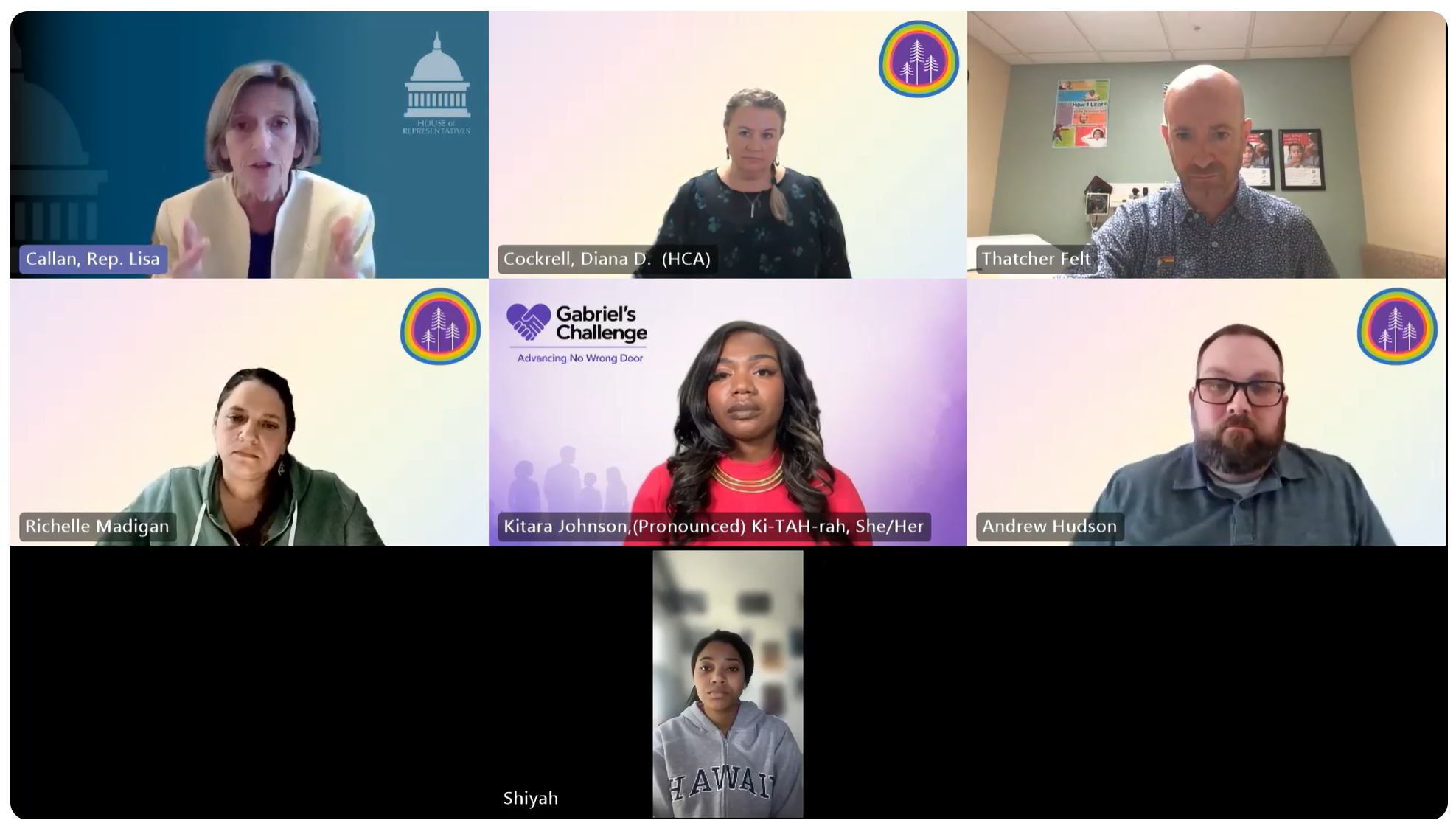
The town hall panel was intentionally constructed to represent voices from across the state and different parts of the system.
View the panelists and their bios here.
Centering these voices from across the behavioral health system models the type of coordinated statewide commitment Washingtonians need for Washington Thriving to be a success as it moves forward with implementation efforts.
Discussion & Insights
During discussion, panelists shed light on their experiences navigating the current behavioral health system and the impacts that existing system infrastructure has had on their lives and communities.
Panelist Shiyah Grant’s work is deeply rooted in her own lived experience as a young person navigating the behavioral health system in Washington State, which led her to become a Certified Peer Support Specialist and the Youth Mobile Response Stabilization Services Lead at the Washington State Behavioral Health Youth Network housed at SPARK. Shiyah shared from her experience why prevention and early intervention matter:
“The way that our systems are currently set up is almost like we're setting up for failure...instead of putting things in place to accommodate the youth or person who's in crisis beforehand. Our system is reactive and looking for things to escalate, which is not how it should be.”
Panelists also shared their vision for a better system – one that centers the needs and wants of young people and families, in equitable, culturally attuned ways.
Kitara Johnson-Jones, fellow panelist and the founder of Gabriel's Challenge in Spokane, shared her vision of what it could look like to do better for young people, families, and communities. Her work focuses on a “no wrong door” community approach where people can access support without barriers:
“No wrong door to me means that wherever a young person or a family shows up that there is coordinated response. That there's not disconnected services, that there's not…never ending referral[s] from one agency to the next. That there are no gaps between systems. …It's warm handoffs and communication that is made for comprehension. …It is simple and people are able to get the help that they need to stabilize and recover. And what I love most, in their own neighborhoods. You shouldn't have to go across the county to get help.
No young person should have to be lucky enough to survive.
...This is an opportunity to create something different. We can create a full system that has warm handoffs instead of drop offs.”
Washington Thriving reflects these stories and builds upon this vision to chart the course for systemic change. A system that is successful is one that reflects the needs and realities of all communities in Washington, including those who have borne the heaviest burden of systemic neglect and harm.
Q&A
Leading up to and during the town hall, the public submitted their questions about Washington Thriving. Common themes included:
Implementation & accountability – appetite for more detail around concrete next steps, governance structures, tracking mechanisms, and near-term roadmaps
Funding & fiscal sustainability – how funding will work, and especially in the current federal & state budget backdrop
Equity for specific populations – how the plan will meaningfully serve groups whose needs risk being overlooked, targeted population-specific strategies
Workforce development – how the state plans to grow and retain a behavioral health workforce that is already stretched thin
Rural & geographic access – how the plan accounts for the reality that “access” looks fundamentally different in different places across the state
The role of community & community-based organizations – Whether communities will be genuine implementation partners or sidelined as budget cuts continue to erode their capacity, how to access plan-related funding, how local jurisdictions can get involved in planning, and what community engagement mechanisms will be built into ongoing governance
Linkages to other systems such as education, medical settings, child welfare, carceral systems, and others – how the plan connects behavioral health supports to other systems and understanding how cross-system coordination will be structures so families don’t have to do it themselves and fall through the gaps between siloed agencies
These themes reveal a deeper question around how the Strategic Plan will be implemented and what it will take to make a real, sustained impact. In particular, how this work will ultimately translate into a less fragmented experience for youth and families — rather than simply coordinating existing silos — remains an open question for many attendees.
As the plan moves into initial implementation, these themes are being actively taken into consideration and will inform future work, events, and communications.
Implementation planning work is already underway: Washington Thriving’s early work is to intentionally establish the structures and ways of working needed to move the plan to action, while deliberately leaving room for the how to be shaped by the diverse voices representing different parts of the ecosystem, like those represented by the panelists: lived experience experts, providers, community organizations, state leaders and system partners, together in conversation.